A booking button visible on every page and on mobile. The form asks only for what is really needed.
Industries · Healthcare
Websites for dental practices, clinics and private medical practices
Patients choose a practice in a few minutes — on a phone, often in the evening. The website must immediately give them three things: trust, clear information and an easy way to book an appointment.
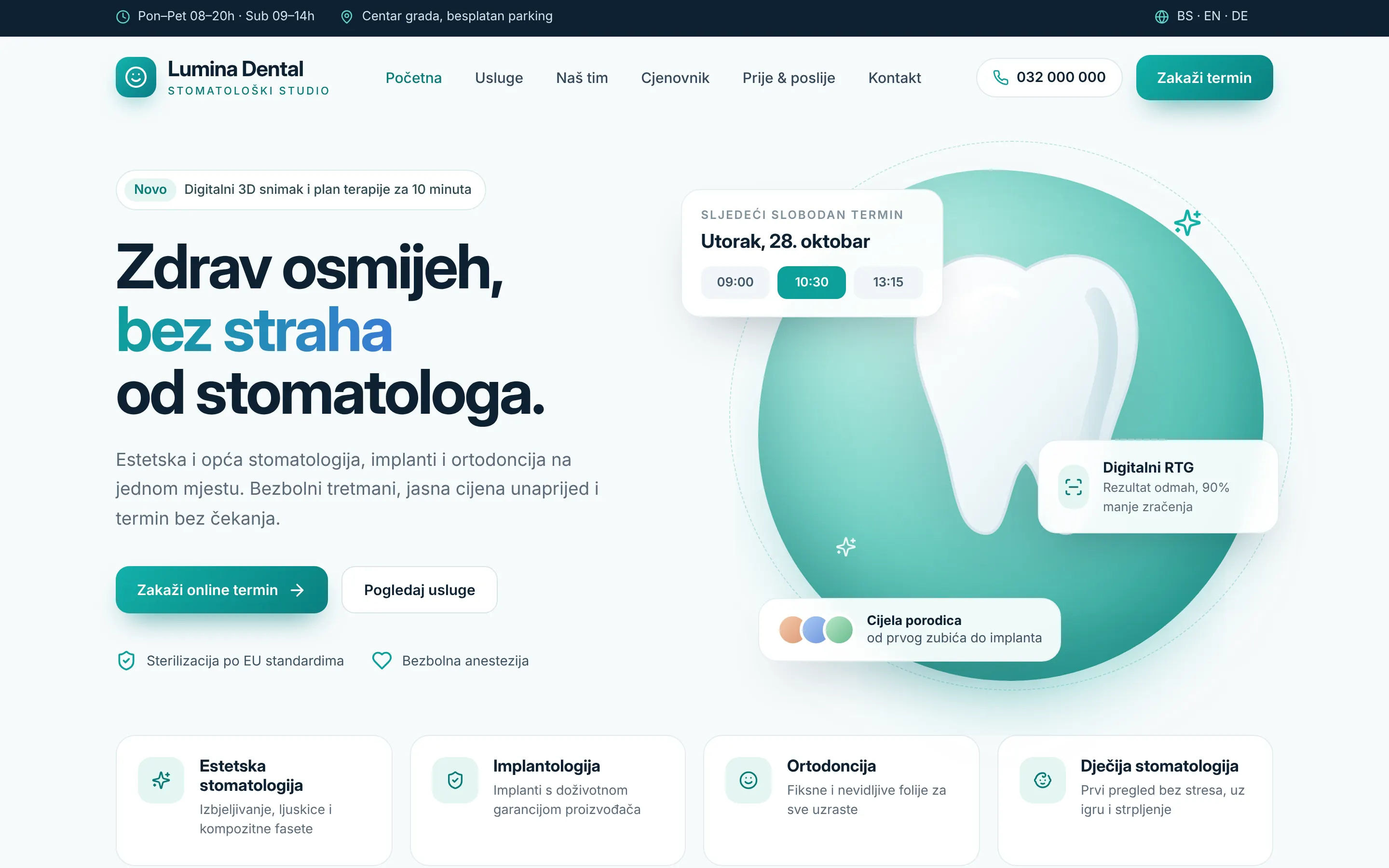
Home page concept · dental practice
Priorities
What a practice needs from its website
A good practice website reduces repetitive phone questions and brings patients who already know what they want.
A dedicated page for each key service — implants, orthodontics, cosmetic dentistry — answering the questions patients actually ask.
Who works at the practice, their experience and specialisations, the premises and equipment. People choose people they trust.
Consistent details, a map, opening hours and parking — and a page that appears when someone searches for a dentist in your town.
The form doesn’t ask for medical details not needed for booking, data travels over an encrypted connection and only authorised staff have access.
A German or English version for patients who travel from abroad — often booking a planned visit for the summer.
Concept
About the concept in the picture
The image at the top is a concept I designed to show what a modern practice home page can look like. Notice a few details that are there on purpose:
- The main message and the booking button are visible right away, without scrolling — that is the one action that actually brings the practice a patient.
- Opening hours, location and parking sit in a bar at the very top, because they are the most common questions on the phone.
- The next free appointment is shown directly on the home page — patients see they won’t have to wait for weeks.
- A language switcher (BS · EN · DE) for patients from abroad who plan visits in advance.
- Services are split into clear categories, each with its own page that can rank on Google.
- A calm colour palette and plenty of space — a practice website should feel calm and professional, not like an advert.
Your website is, of course, designed from scratch around your brand, premises and the patients you want to attract.
Experience and rules
What to watch out for with healthcare websites
Trust comes first
A patient isn’t buying a product — they are entrusting their health. So the website should show real people, real premises and clear information: what a treatment involves, how long it takes, how to prepare and what happens afterwards. Generic stock photos and empty slogans do the opposite.
Informative, not promotional
Advertising healthcare services is subject to professional rules and regulations. That’s why we write informative copy — no promised outcomes, no “best” or “guaranteed” treatments — and the practice always approves the final content.
Protecting patient data
A website is not a medical record. An appointment form should collect the minimum (name, contact, preferred time, possibly the type of service), send it over HTTPS and not keep it longer than necessary. If you have patients from the EU, GDPR applies as well — we discuss this before development starts.
Planning a new website for your practice?
Send the address of your current website (if you have one) and a few sentences about your practice. I’ll reply with a proposed structure and a fixed quote.
FAQ
Frequently asked questions
Can patients book an appointment through the website?
Yes. The simplest solution is an appointment request form (preferred day, time and service) that arrives by email or phone, and you confirm the appointment. If you use scheduling software with an online module, the website can be connected to it.
Are we allowed to publish prices on the website?
Many practices publish an indicative price list because patients look for it and it builds trust. What and how you may advertise depends on the regulations and professional rules for your field — so we write copy that informs, without promising treatment results.
How does the website help people find us on Google Maps?
Through consistent business details (name, address, phone), dedicated service pages, structured data and a link with your Google Business Profile. It’s explained in detail in the guide on appearing on Google Maps.
You might also find useful
-
Scheduling
Online appointment booking: a guide for practices, clinics and salons
Ready-made service or custom system, reminders, data protection and mistakes to avoid.
Read the guide -
Data protection
Bosnia’s new data protection law: what your website needs
Privacy policy, cookies, forms and analytics — a practical checklist for compliance.
Read the guide -
Local SEO
How to appear on Google Maps: Google Business Profile step by step
Creating and verifying a Google Business Profile, reviews, local ranking and mistakes to avoid.
Read the guide -
Website development
Unique, fast websites for companies and sole traders — mobile-first, with technical SEO from day one.
Learn more -
Pricing
How much does a website cost in Bosnia and Herzegovina in 2026?
Realistic price ranges on the Bosnian market, yearly costs and how to compare quotes without surprises.
Read the guide -
Accessibility
Website accessibility (WCAG): what it is and how to check it
WCAG 2.1 AA explained simply, plus a check you can do yourself in 15 minutes.
Read the guide
Contact
Have a project in mind? Let's talk.
Describe your idea in a few sentences. I'll reply personally within 24 hours on business days, with clear next steps.
Emailinfo@engimotive.com
LocationZenica, Bosnia and Herzegovina
Working modeRemote — Europe and worldwide
What happens next: a reply with a few questions → a short call → a fixed quote. No obligation.